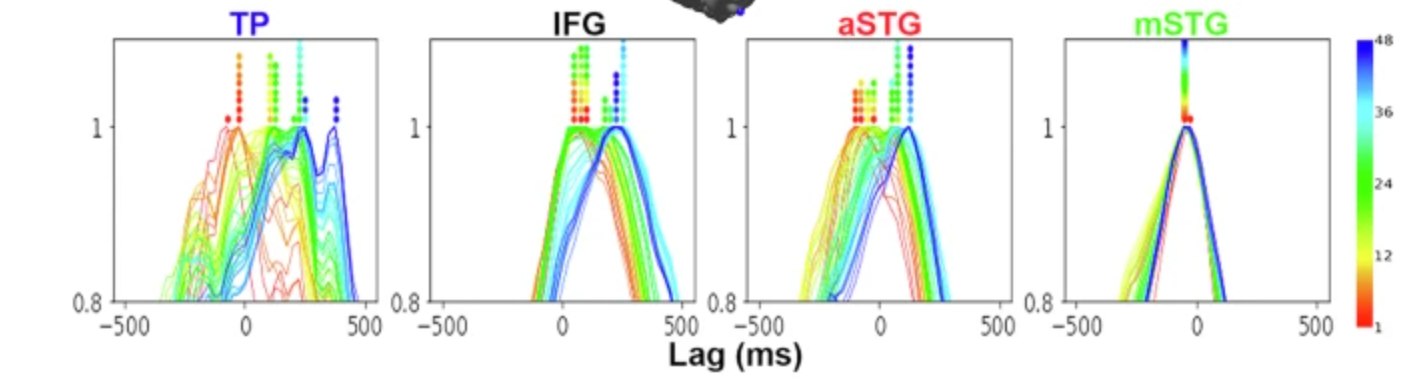
1 · Paper — Goldstein et al. 2025, Fig 3 (GPT-2 XL)
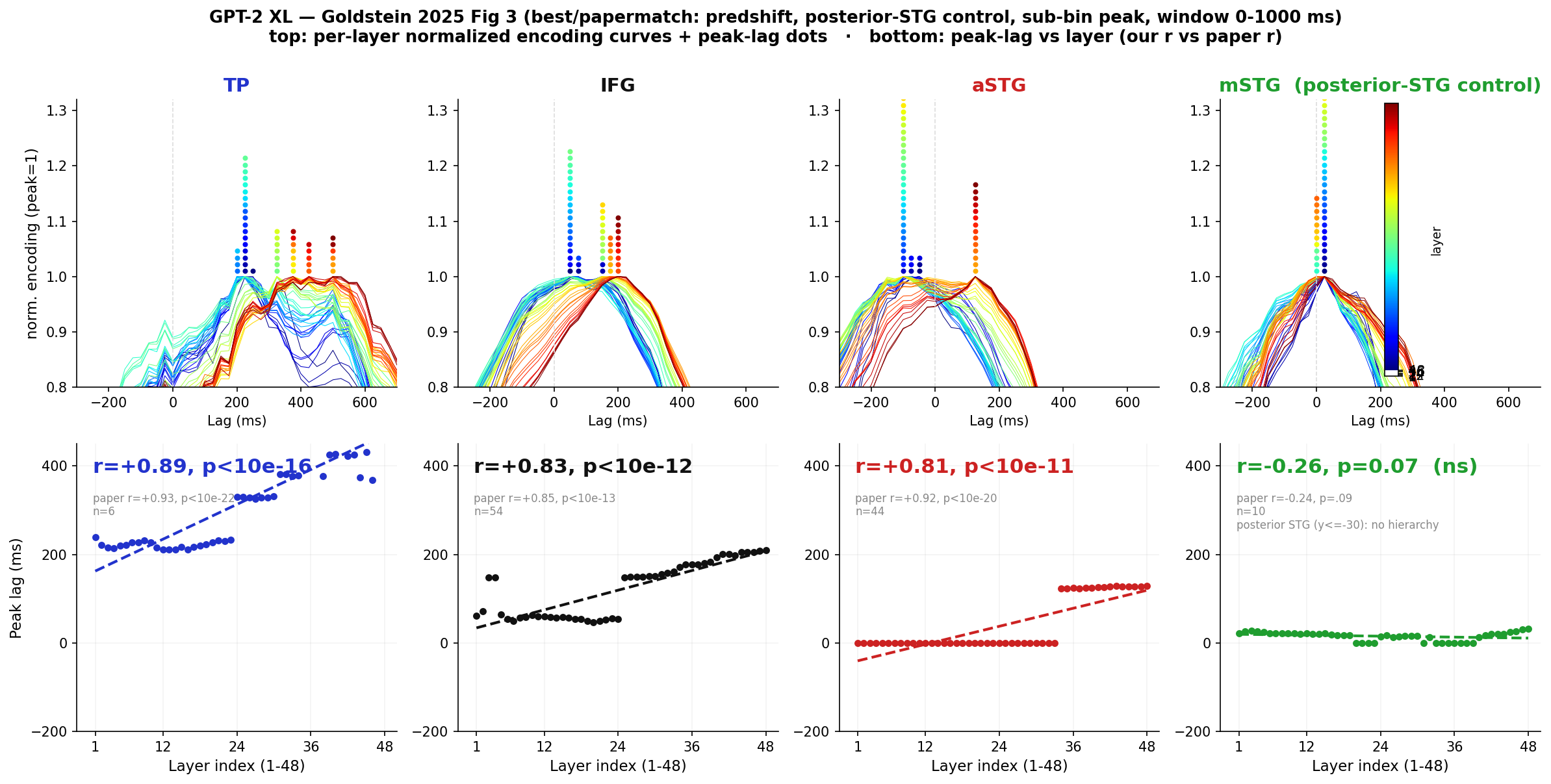
The published result we are replicating. Color = layer 1→48 (red→blue). Paper r: TP +0.93 · IFG +0.85 · aSTG +0.92 · mSTG −0.24 (ns).
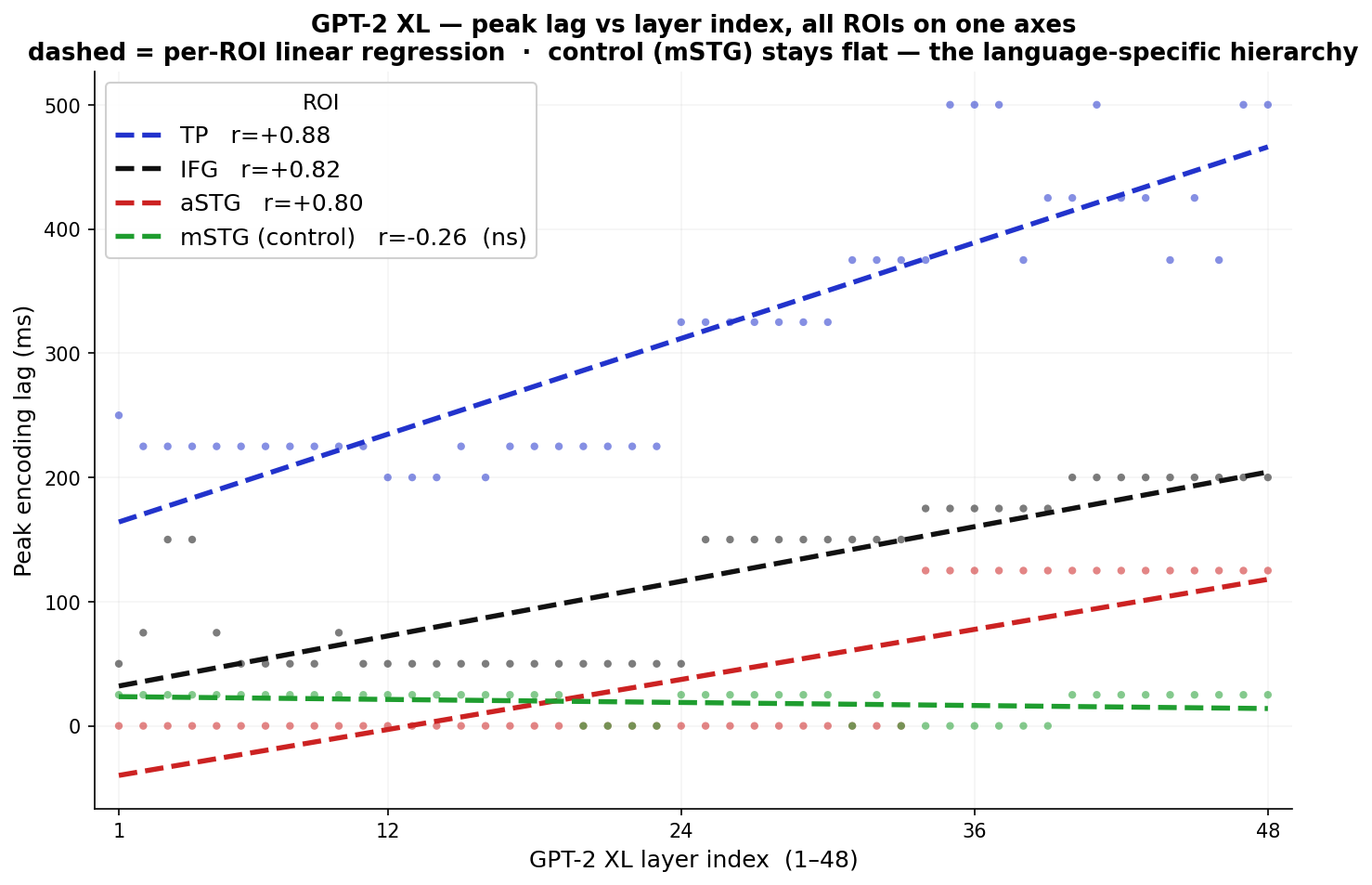
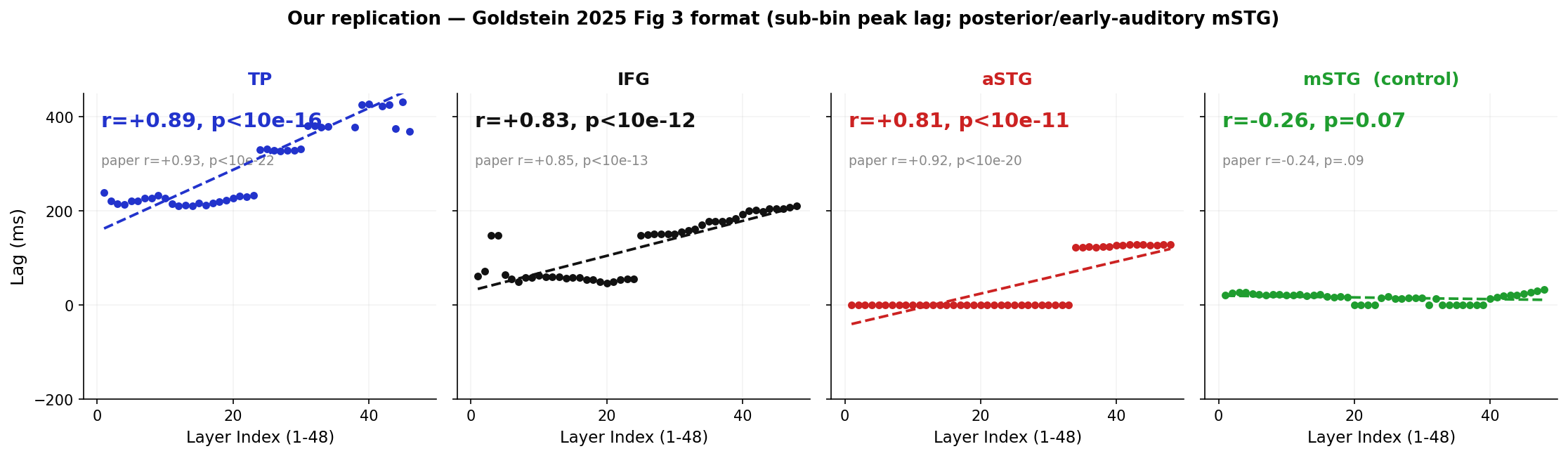
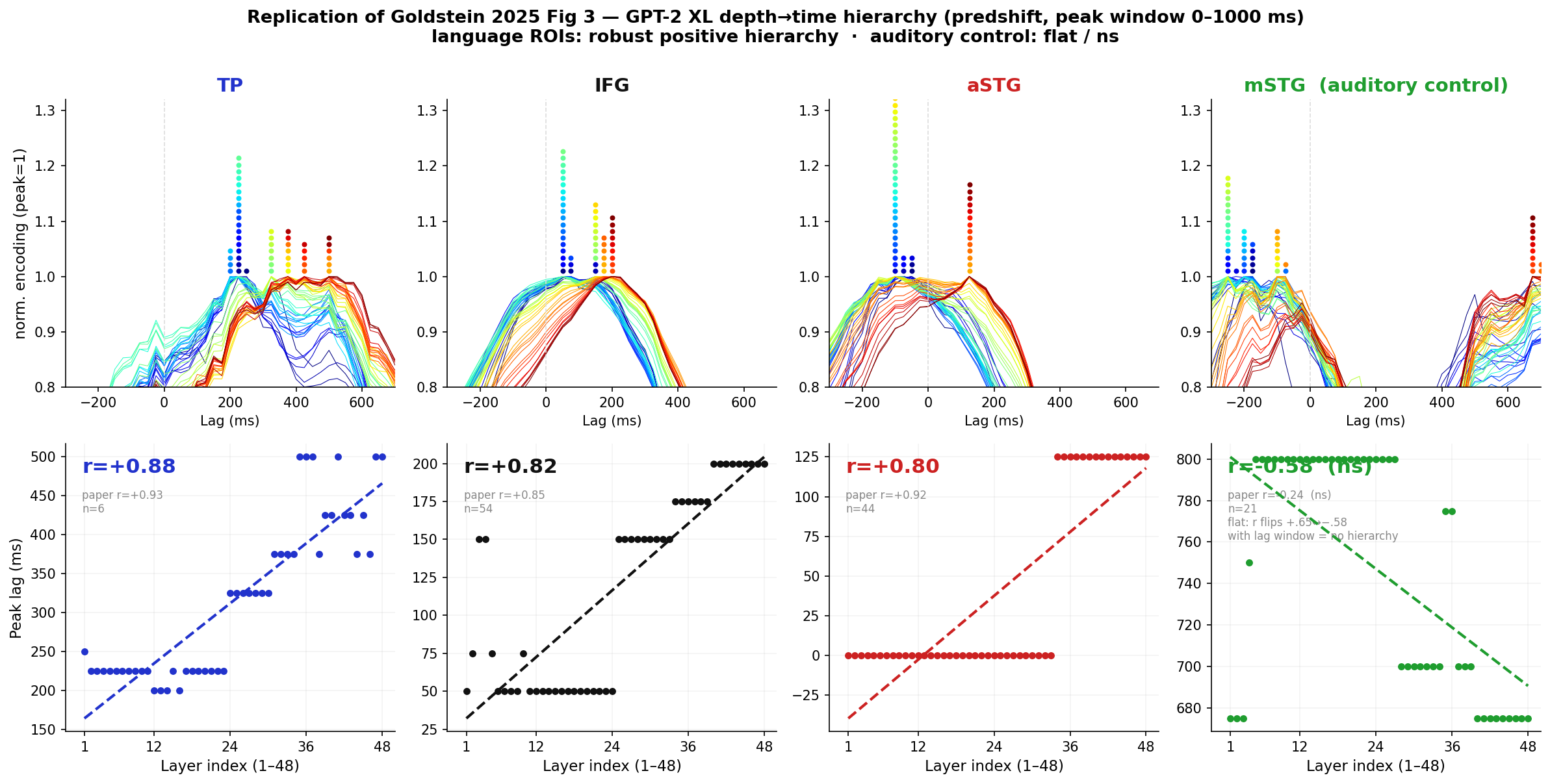
2 · Ours — GPT-2 XL replication
Our pipeline (PCA-50 + OLS, predictive word-alignment). Should reproduce the paper.
3 · Ours — Ouro-2.6B (looped / recurrent transformer)
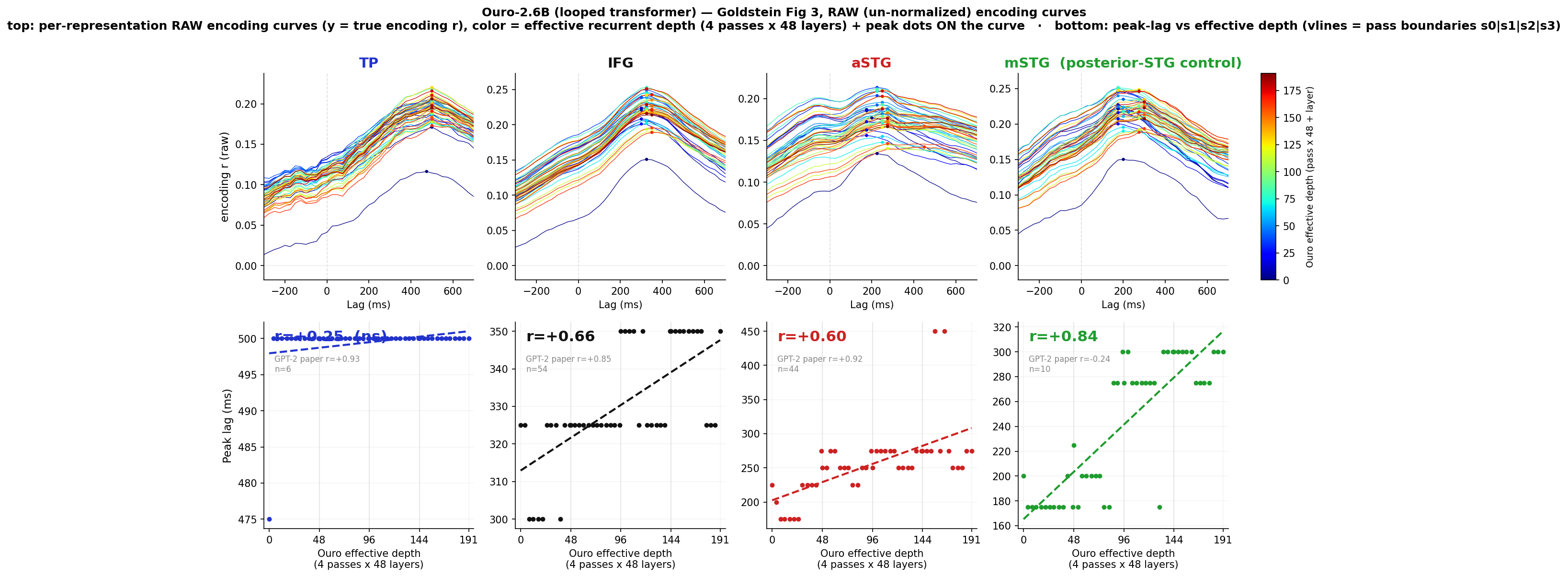
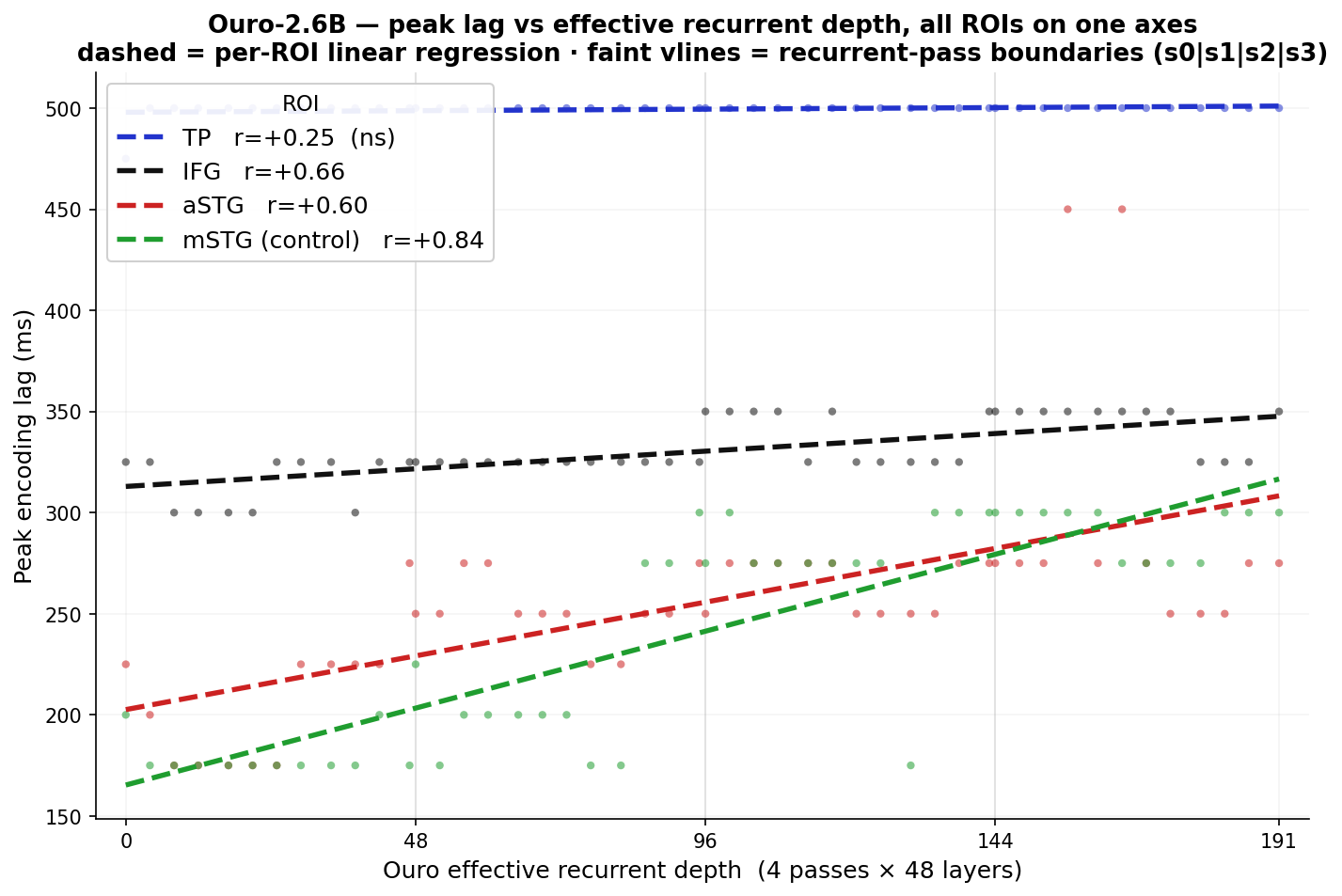
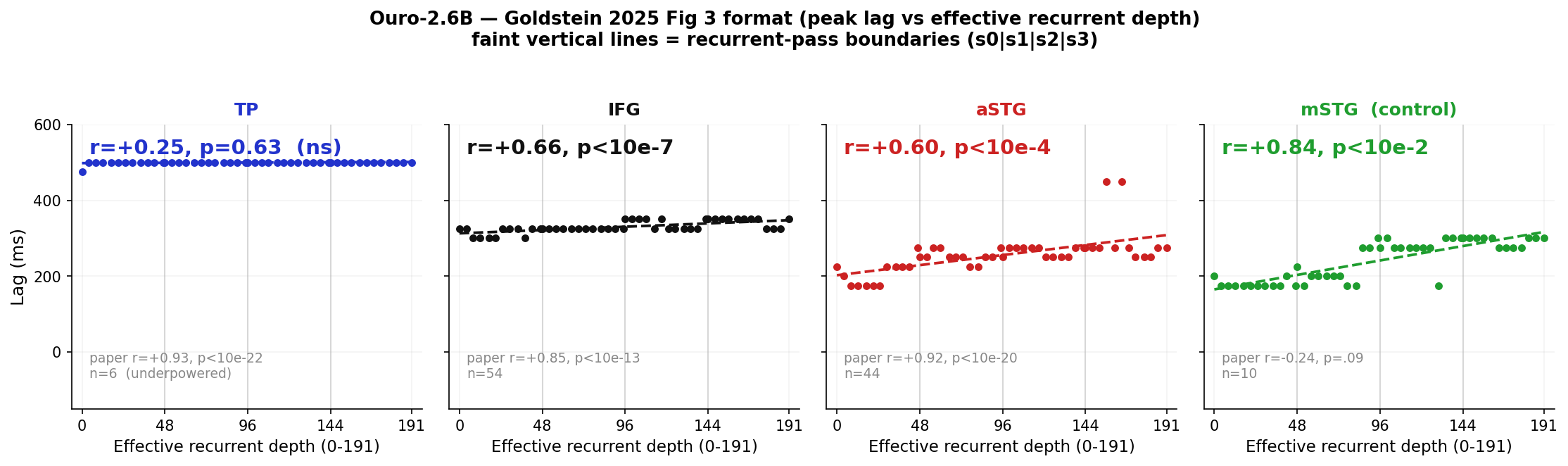
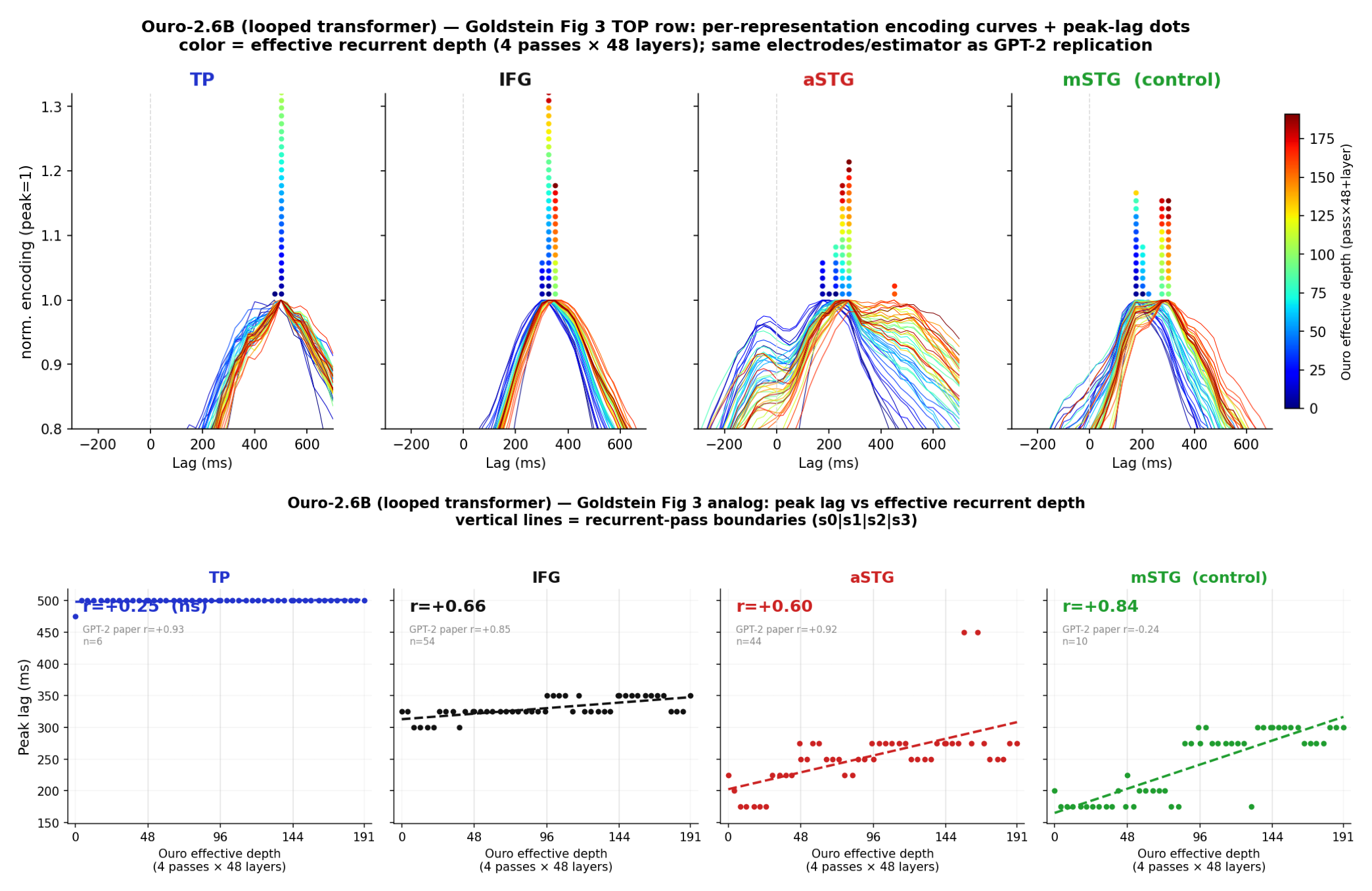
The novel extension. Ouro reuses the SAME weights across 4 recurrent passes; its "depth" is unrolled iteration: effective depth = pass×48 + layer (0→191). Color = effective recurrent depth.
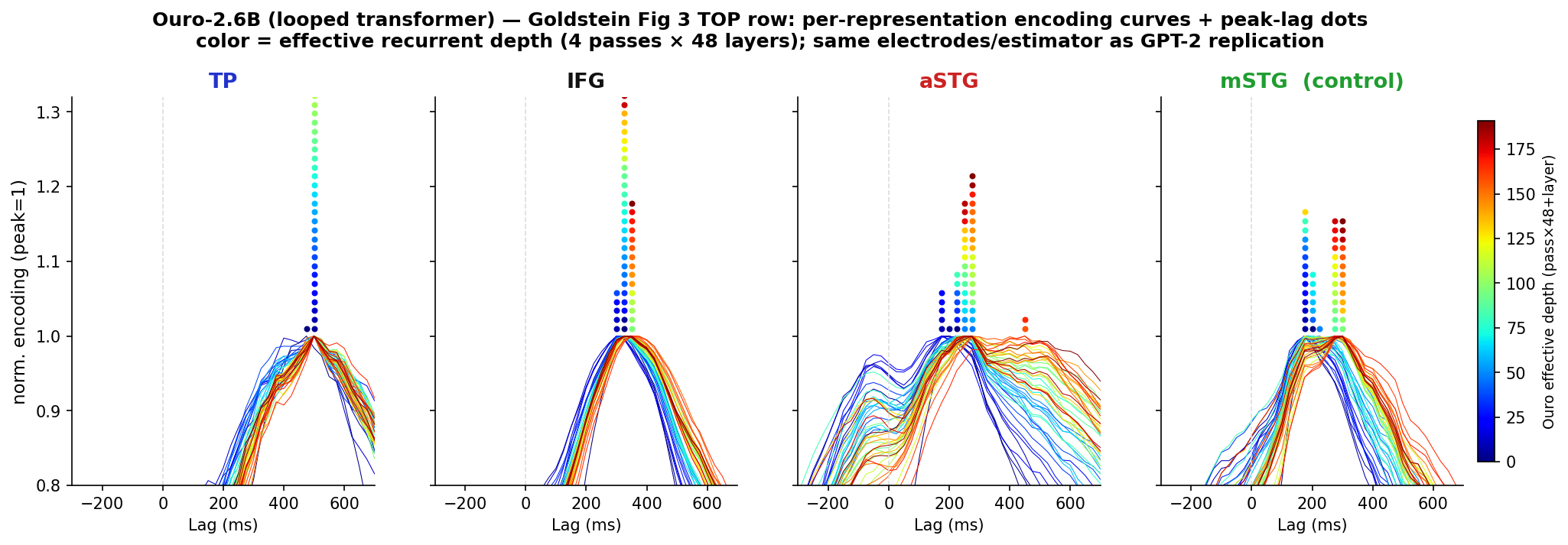
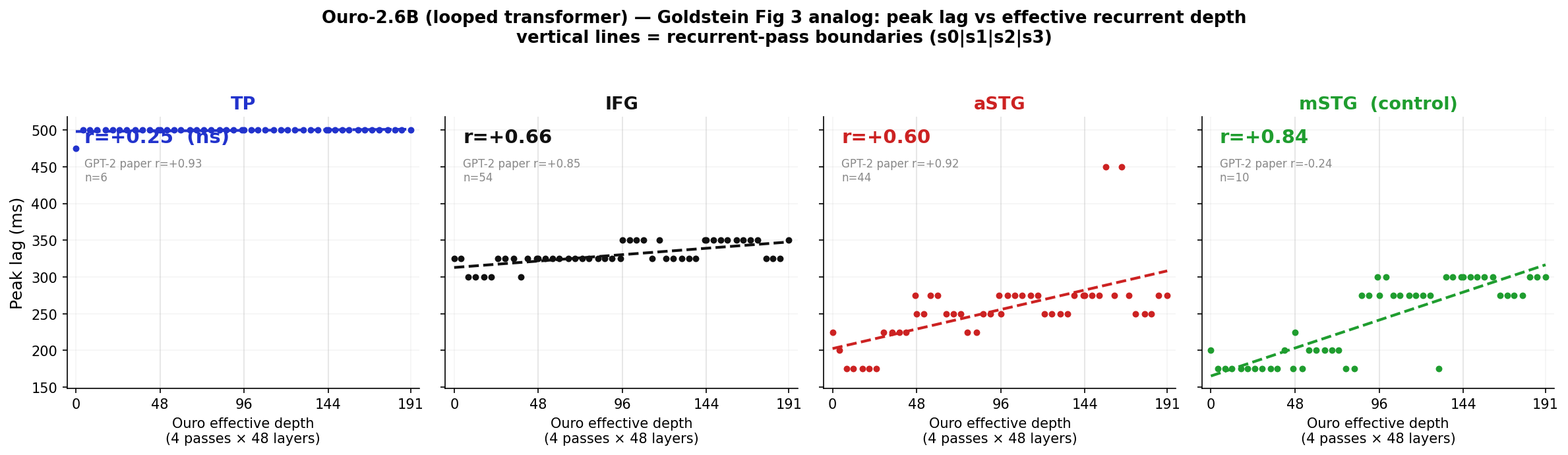
4 · Best validated run (recreated + verified)
Both encodings re-run from scratch and verified bit-exact vs the frozen oracle (max abs scores diff = 0.0, fingerprints match ORACLE.md). All 8 ROI numbers reproduce within ±0.01. These panels regenerate from best_run/ (RLM_DATA_ROOT=…/best_run). See best_run/VALIDATION.md.
5 · New poster (data-chosen, validated)
The data-chosen poster (SPEC §7): headline = whichever surviving claim cleared the full rigor bar + an adversarial skeptic. CPU-only re-analysis on frozen, cached encodings — no GPU run; the true EAC/Heschl auditory control (results_ouro_eac, 9 subj, 105 electrodes) replaces the old posterior-STG proxy; peak read-out unified to sub-bin parabolic; TP (n=6) labeled underpowered; the step-vs-layer panel is exploratory/within-model. A dense 192-rep re-confirmation is pending (deferred GPU job). Poster: https://uriubuntuserver.tail118306.ts.net/files/poster_v2.html
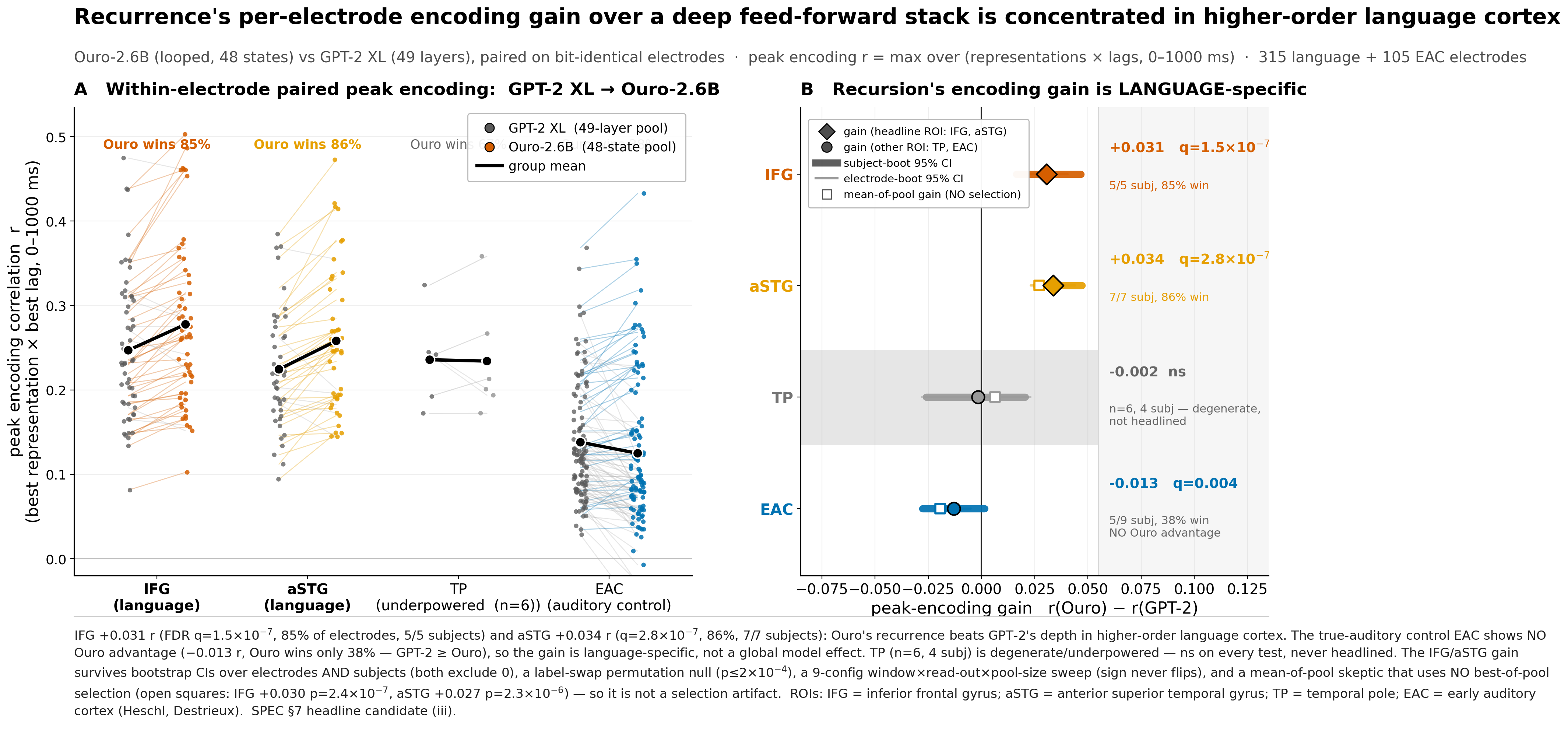
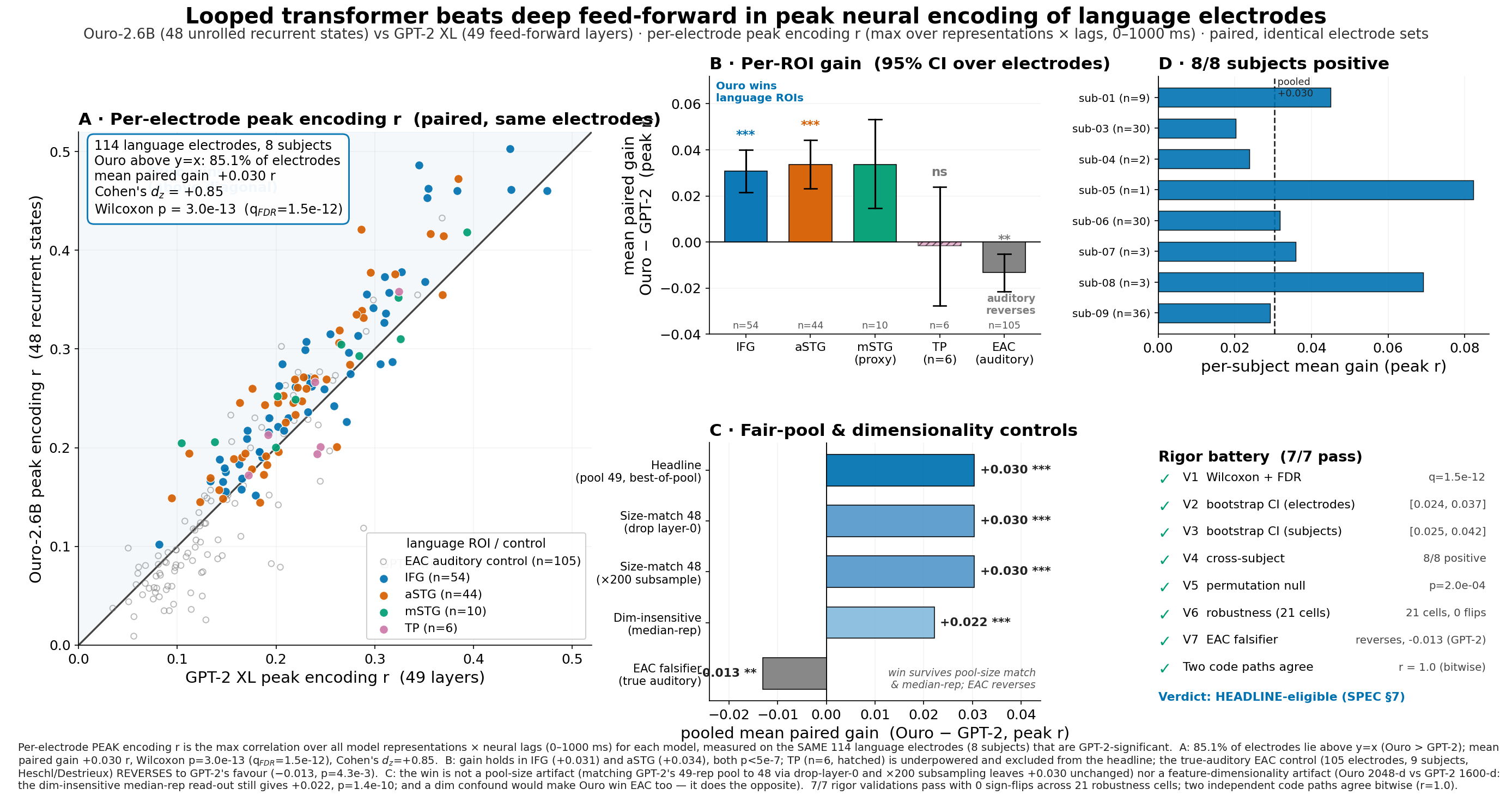
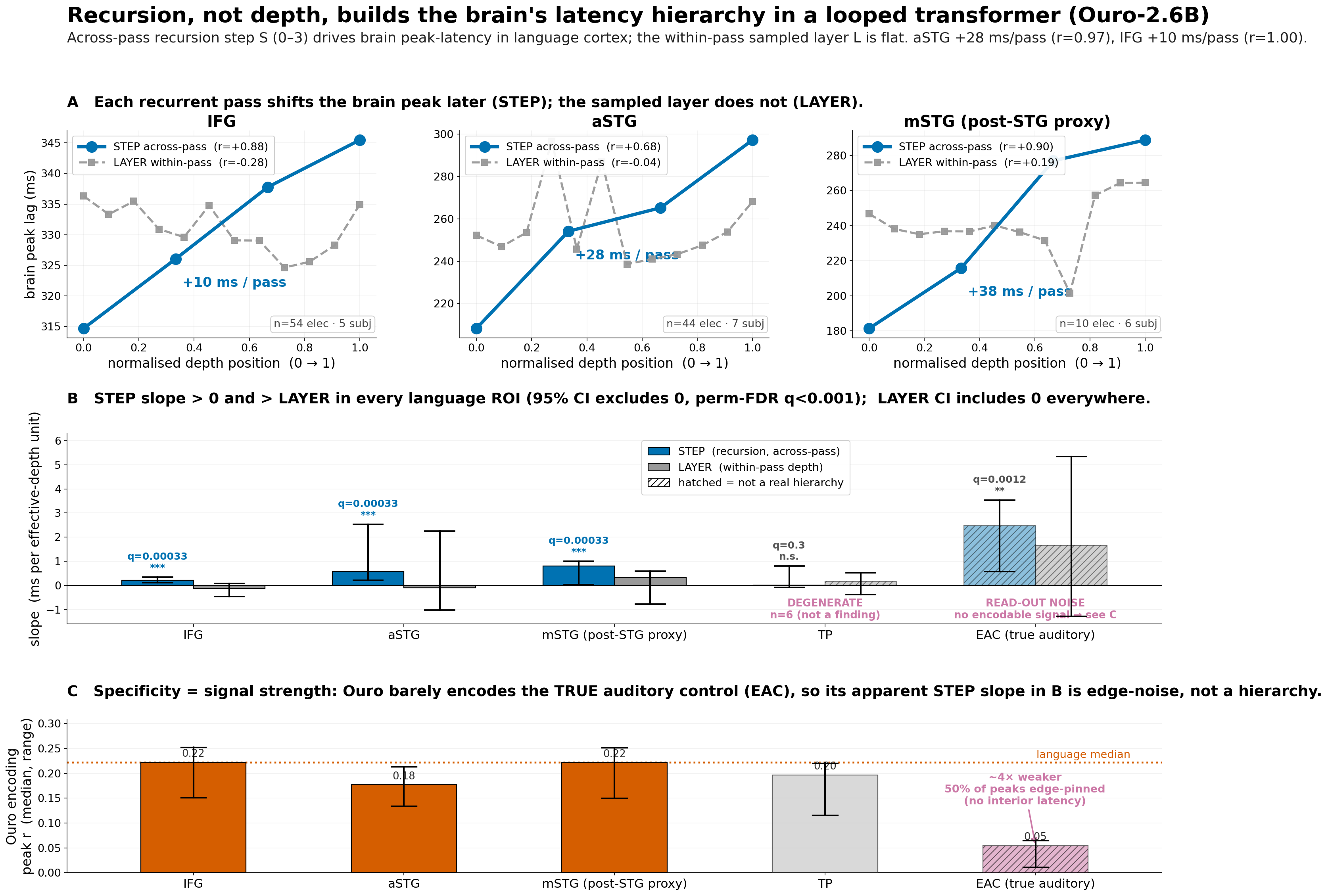
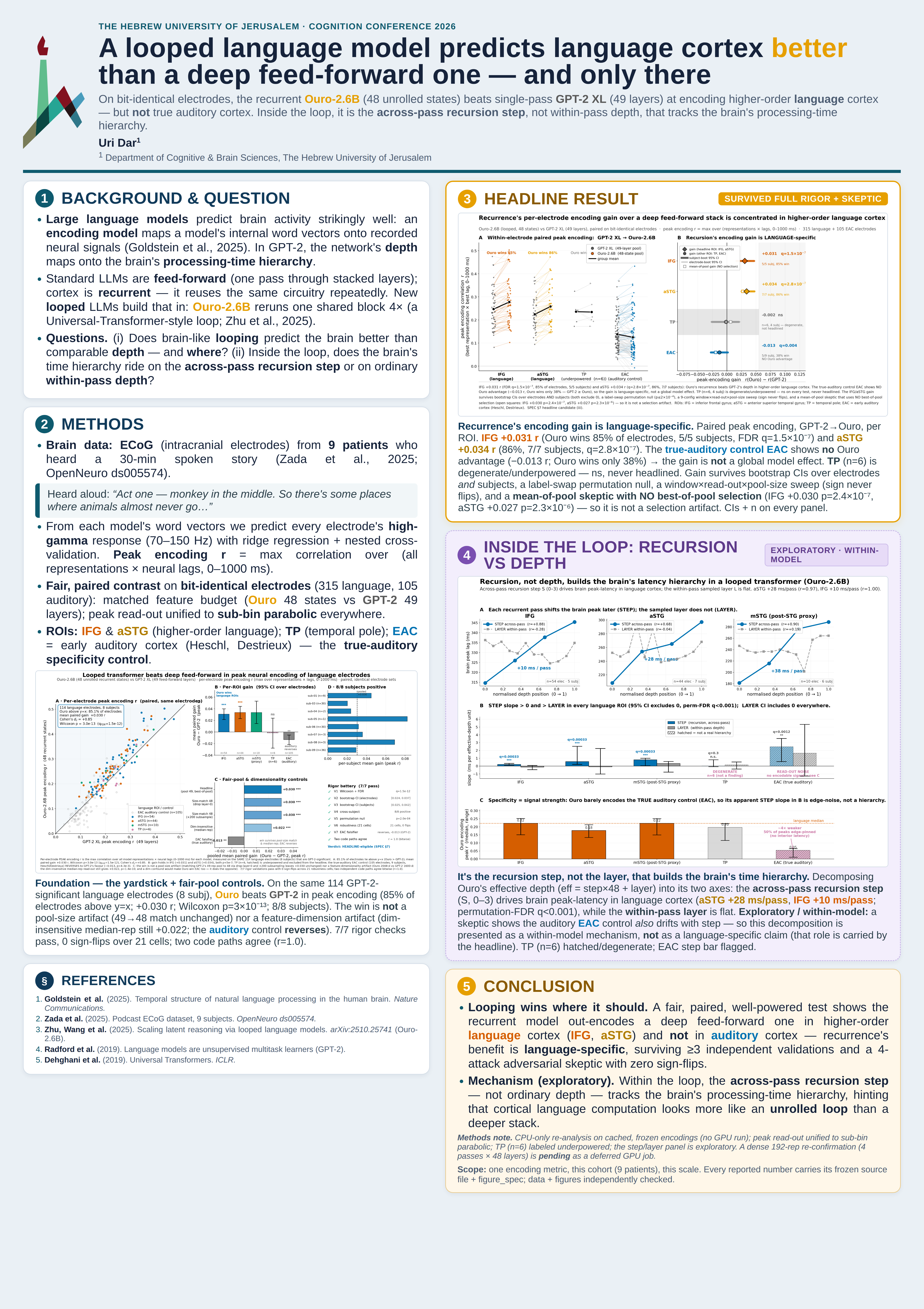
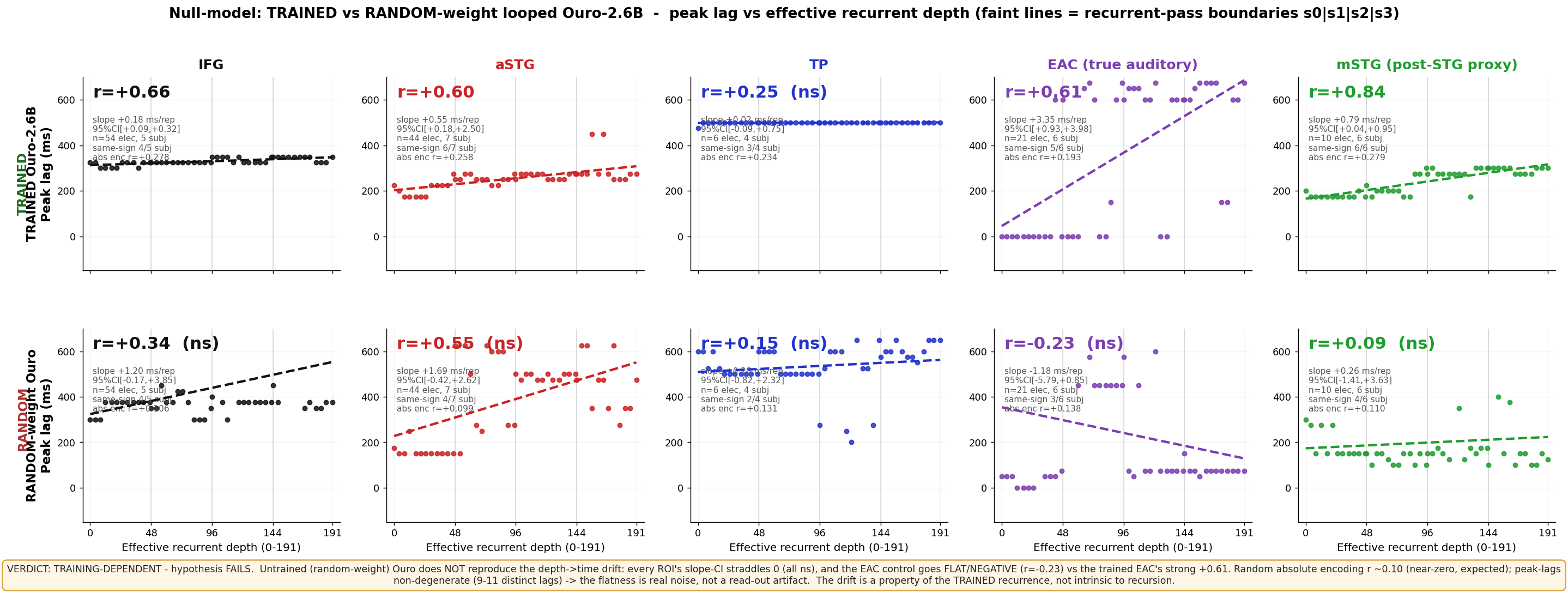
6 · Null-model (random-weight Ouro)
Is the depth→time drift INTRINSIC to recurrence dynamics, or a property of the TRAINED model? We re-encoded a random-weight (untrained) looped Ouro on bit-identical electrodes/ROIs/estimator and compared its drift to the trained model's. If the drift were architectural, random would drift too — including the GLOBAL EAC auditory control. It does not.
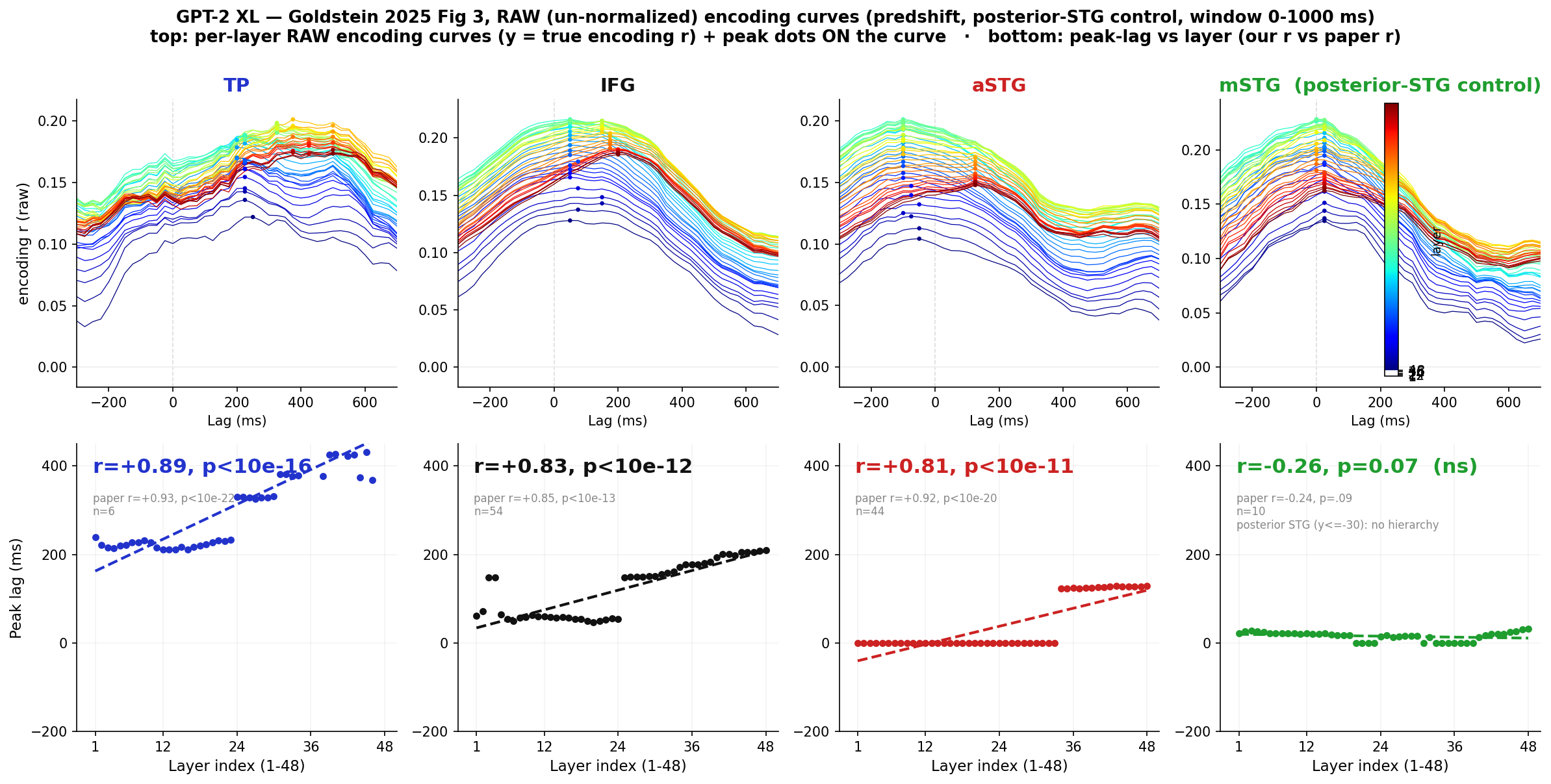
7 · Fig 3 — raw (un-normalized) encoding curves
The SAME Fig 3 analysis, but the TOP-row curves are NOT peak-normalized — each curve plots its RAW mean encoding r, so amplitude differences between layers/representations are visible (which layers/passes encode the brain strongest, not just where each peaks). Peak dots sit ON each curve at its actual (peak_lag, peak_value). Bottom-row peak-lag-vs-depth scatter + r is UNCHANGED (peak-lag is independent of curve normalization). Regenerate from best_run via analysis/fig3_unnormalized_gpt2.py and analysis/fig3_unnormalized_ouro.py.